


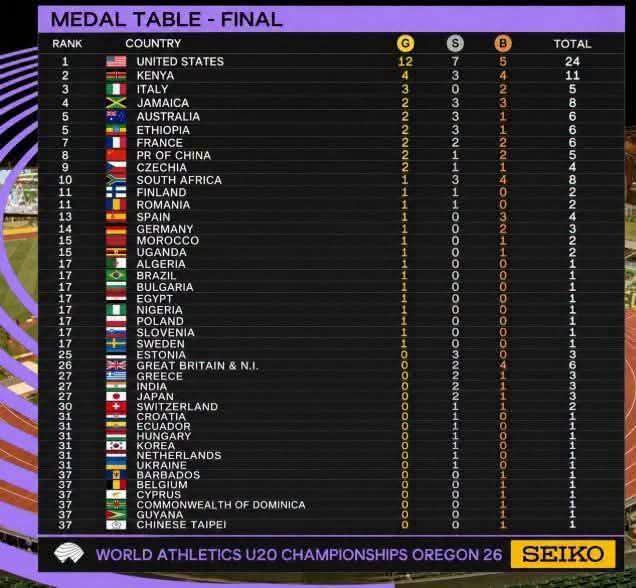
The latest medal table from the World Athletics U20 Championships in Oregon should force Nigerians to look beyond the familiar habit of blaming every sporting failure on the Nigeria Football Federation (NFF).
The table tells a sobering story.
While the United States leads with 12 gold, seven silver and five bronze medals, Kenya sits impressively in second position with four gold, three silver and four bronze medals. Italy is third with three gold and two bronze, while Jamaica, Australia, Ethiopia and other nations also occupy prominent positions.
Nigeria, meanwhile, is listed 17th, with just one gold medal and no silver or bronze medal.

That is not merely an athletics problem.
It is a Nigerian sports administration problem.
And it raises a fundamental question: If Kenya can develop athletes capable of putting the country second in the world at the U20 level, why is Nigeria—blessed with enormous sporting talent—struggling so badly?

Stop Making Football the Scapegoat


For years, whenever Nigerian sport fails, the conversation quickly turns to football and the NFF.
Certainly, the NFF must be held accountable whenever football administration falls short. But Nigeria’s sporting ecosystem is much bigger than football.
Athletics, basketball, boxing, wrestling, swimming, weightlifting, table tennis and several other sports require deliberate investment, talent identification, coaching development, competition structures, sports science and athlete welfare. In Basketball, Nigeria’s U18 team just suffers group stage exit after three straight defeats and no one is calling the heads of the NBBF leadership.
Coming back to the National Sports Commission gallivanting over 10 gold in Commonwealth that Nigeria tops the Africans as if Nigeria competed with Africans. This is a glibal stage and its not an African business.
The Oregon medal table therefore presents an uncomfortable question for the National Sports Commission (NSC) and the wider sports administration:
Where is Nigeria’s long-term sporting development plan?
The National Sports Commission Act assigns the Commission responsibilities including encouraging the development and organisation of sports and coordinating efforts to raise sporting performance standards across Nigeria.
Therefore, Nigerians should demand accountability across the entire sports architecture—not selectively.
Kenya’s Success Is a Mirror
Kenya’s second-place position should not simply be celebrated as an African success story.
It should be studied.
What are the Kenyans doing differently?
How are they identifying young athletes?
How are they preparing them?
How are coaches being developed?
How are athletes supported before they become international stars?
And most importantly, why can’t Nigeria build a sustainable system that produces champions instead of waiting for individual talents to emerge by accident?
Nigeria has no shortage of natural ability.
What appears to be missing is the consistency of the system.
But Then Comes Football—and Another Question
There is also a legitimate debate about the relationship between the NSC and the NFF.
The NSC has publicly stated that its destiny is tied to that of the NFF, with Chairman Shehu Dikko saying in 2025: “If the NFF succeeds, we succeed. If the NFF fails, we fail.” This statement sounds collaborative.
But Nigerians are entitled to ask whether the relationship is genuinely one of support and coordination, or whether government sports administrators are increasingly becoming too involved in areas that should primarily be handled by the football federation.
The NFF itself has repeatedly acknowledged the NSC’s support for its programmes and national teams. This means that whatever the NFF does is tied to the NSC
So the issue should not be whether government should support football.
Of course government should support football.
The real question is: Where does support end and interference begin?
Did the Timing of the Falcons’ Rewards Make Sense?
The Super Falcons entered the 2026 WAFCON as defending champions, and the Federal Government had promised the players substantial rewards following their previous continental triumph, including $100,000 for each player and three-bedroom apartments.
The housing presentation eventually took place in Morocco shortly before Nigeria’s opening match, with the NSC explaining that the timing was deliberately chosen to boost morale while the players were together. Punch Newspaper claims that the explanation deserves scrutiny—not necessarily because rewarding the players was wrong, but because timing matters in elite sport.
Players preparing for a major international tournament need concentration.
Training, recovery, tactics, psychology and match preparation should dominate the final hours before competition.
When major financial announcements, housing documentation, government ceremonies, photographs and public engagements are introduced into that environment, Nigerians are entitled to ask:
Was this the best time?
And where does the reported claim of $10 million per goal actually come from?
That particular figure should not be presented as an established government commitment without documentary confirmation. What is clearly documented is the Federal Government’s $100,000-per-player reward and housing package.
Who Should Lead the Football Delegation?
There is another uncomfortable question.
Why should the leadership of the sports administration routinely become the most visible presence around national football teams—travelling, appearing in photographs and making announcements—while the NFF, the statutory football governing body, sometimes appears to be playing second fiddle?
Government officials are entitled to support national teams.
But support should not become institutional overshadowing.
If public money is being spent on official travel, Nigerians deserve transparency about the purpose, size and cost of every delegation.
If an official trip is necessary, let it be justified.
If it is ceremonial, let the public know.
If it is technical, explain the technical responsibility.
And if the NFF is ultimately responsible for football administration, then its leadership should not be reduced to a background role whenever the cameras arrive.
Perhaps the biggest issue is accountability.
If the NSC has significant influence over the environment in which national teams operate, then Nigerians must stop accepting a situation where everyone wants credit when things go well, but the NFF alone carries the blame when things go wrong.
That is not accountability.
That is selective accountability.
The NSC itself has publicly acknowledged that it supports the NFF, while the NFF has acknowledged the NSC’s interventions.
Therefore, when success comes, let everybody who contributed take the applause.
When failure comes, every institution involved should answer questions according to its actual responsibility.
Nigeria Needs a Sports Governance Reset
The Oregon medal table should therefore become more than a statistical document.
It should become a national conversation.
One gold medal and 17th position should concern us.
Not because medals are everything, but because medals often reveal the strength or weaknessof the system behind the athletes.
Nigeria must stop managing sport from tournament to tournament, rather we we need national talent-identification pipeline.
Serious investment in grassroots and school sports. Better coaching and sports-science programmes.Transparent funding, Proper athlete welfare, stronger domestic competitions.
Clear institutional boundaries between government and sports federations, Professional delegation and travel policies.
Independent performance evaluation.
And, above all, accountability without scapegoating.
Football cannot continue to carry the entire burden of Nigeria’s sporting failures. The NFF must answer for football.
The Athletics Federation must answer for athletics. Other federations must answer for their respective sports and the National Sports Commission must answer for the overall national sports development architecture within its mandate.
Because when Nigeria finishes 17th with one gold medal while Kenya finishes second, the question is not simply:
“What is wrong with Nigerian football?”
The bigger question is:
“What is wrong with Nigerian sports administration?”
And until we are courageous enough to ask that question, we may continue celebrating isolated victories while the larger sporting system quietly collapses around them.
