African football is set for a major calendar overhaul following a new policy direction announced by the Confederation of African Football (CAF). Central to the reforms is the decision to stage the Africa Cup of Nations (AFCON) once every four years from 2028, ending the tournament’s long-standing biennial format.
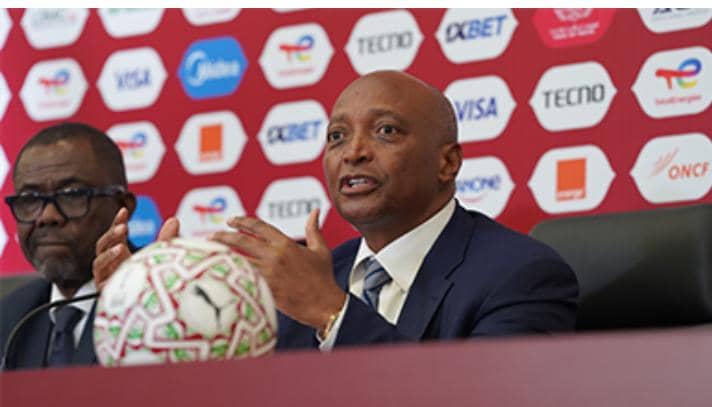
CAF President, Dr. Patrice Motsepe, announced the decision on Saturday during a press conference at the Moulay Abdellah Complex, describing it as part of a broader strategy to modernise African football and align its competitions more closely with the global football calendar.
Under the new arrangement, AFCON will be played in even-numbered years, placing it in the same year as the Olympic Games. CAF believes the shift will ease pressure on players and clubs while allowing African competitions to fit more smoothly into FIFA’s international match windows.
Motsepe confirmed that the 2027 Africa Cup of Nations will go ahead as scheduled. That edition will be jointly hosted by Kenya, Tanzania and Uganda and will be staged during the summer.
Beyond AFCON, CAF also announced the introduction of a newly created African Nations League, which will debut in 2029 as an annual competition. The Nations League is designed to replace most international friendlies with regular, high-level competitive matches for national teams, ensuring consistent engagement and development across the continent.
CAF said the restructuring is aimed at bringing greater order and balance to African football scheduling. By synchronizing AFCON with major global tournaments such as the FIFA World Cup and the UEFA European Championship, the body hopes to reduce clashes with club football and create better preparation windows for players.
In addition to the calendar reforms, CAF announced a significant increase in prize money for its flagship competitions. Total prize money for AFCON has been raised from 7 million dollars to 10 million dollars, with the increase taking immediate effect, beginning with the ongoing Africa Cup of Nations in Morocco.
CAF’s major club competitions will also benefit from enhanced financial rewards. Motsepe disclosed that prize money for the CAF Champions League and the CAF Confederation Cup will be increased, although specific figures will be announced after the conclusion of AFCON Morocco 2025.
For African players based in Europe, the changes could prove decisive. A four-year AFCON cycle is expected to ease the physical and mental strain caused by congested schedules, offering improved recovery periods and more sustained performance at both club and international levels.
The reforms are also likely to address long-standing concerns from European clubs over mid-season player absences. With a clearer and more predictable international calendar, tensions surrounding player release for AFCON duty may gradually ease.
The Africa Cup of Nations was first staged in 1957 and was originally held in odd-numbered years before switching to an even-year format in 1968. The tournament reverted to odd-numbered years in 2013. From 2028, AFCON will permanently return to an even-year cycle.
Overall, CAF’s new approach signals a shift toward long-term planning, competitive consistency, and stronger alignment with the global football ecosystem, representing one of the most significant structural and financial reforms in the history of African football.